

크기와 방향을 함께 가진 양을 벡터라 한다. 힘, 속도, 변위가 벡터이다. 벡터를 이용하면 도형의 성질을 좌표 없이도 계산할 수 있고, 내적을 통해 길이와 각을 다룰 수 있다.
핵심 개념
- 벡터의 덧셈: 평행사변형법(또는 삼각형법). 성분으로는 $(a_1,a_2)+(b_1,b_2)=(a_1+b_1,a_2+b_2)$
- 크기: $|\mathbf a|=\sqrt{a_1^2+a_2^2}$
- 내적: $\mathbf a\cdot\mathbf b=|\mathbf a||\mathbf b|\cos\theta=a_1b_1+a_2b_2$
- 수직 조건: $\mathbf a\cdot\mathbf b=0$, 평행 조건: $\mathbf b=k\mathbf a$
- 직선의 벡터방정식: $\mathbf p=\mathbf a+t\mathbf u$ (점 $\mathbf a$를 지나고 방향 $\mathbf u$)
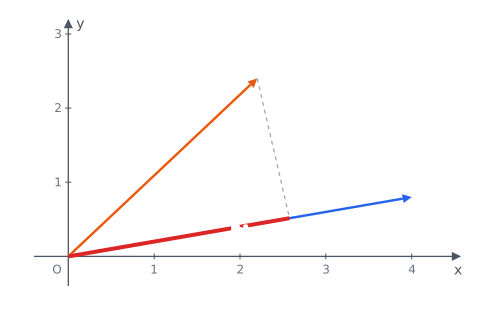
핵심 정리
두 정의 $|\mathbf a||\mathbf b|\cos\theta$와 $a_1b_1+a_2b_2$는 같다.
증명 보기
아이디어. 코사인법칙을 벡터로 쓰면 두 식이 연결된다.
$\mathbf a$와 $\mathbf b$가 만드는 삼각형의 세 번째 변은 $\mathbf a-\mathbf b$이다. 코사인법칙에 의해
$$|\mathbf a-\mathbf b|^2=|\mathbf a|^2+|\mathbf b|^2-2|\mathbf a||\mathbf b|\cos\theta$$
이다. 성분으로 쓰면 왼쪽은 $(a_1-b_1)^2+(a_2-b_2)^2=|\mathbf a|^2+|\mathbf b|^2-2(a_1b_1+a_2b_2)$이다. 두 식을 비교하면
$$|\mathbf a||\mathbf b|\cos\theta=a_1b_1+a_2b_2$$
이다. $\blacksquare$
예제
- $\mathbf a=(1,2)$, $\mathbf b=(3,-1)$: $\mathbf a\cdot\mathbf b=3-2=1$, $\cos\theta=\frac{1}{\sqrt5\sqrt{10}}=\frac{1}{5\sqrt2}$
- 마름모의 두 대각선은 수직이다: 두 변을 $\mathbf a$, $\mathbf b$ ($|\mathbf a|=|\mathbf b|$)라 하면 대각선은 $\mathbf a+\mathbf b$, $\mathbf a-\mathbf b$이고 $(\mathbf a+\mathbf b)\cdot(\mathbf a-\mathbf b)=|\mathbf a|^2-|\mathbf b|^2=0$이다.
- 삼각형의 무게중심: $\mathbf g=\frac{\mathbf a+\mathbf b+\mathbf c}{3}$
확인 문제
$|\mathbf a|=2$, $|\mathbf b|=3$, $|\mathbf a+\mathbf b|=4$일 때 $\mathbf a\cdot\mathbf b$와 $|\mathbf a-\mathbf b|$를 구하시오.
풀이 보기
$|\mathbf a+\mathbf b|^2=|\mathbf a|^2+2\mathbf a\cdot\mathbf b+|\mathbf b|^2$이므로 $16=4+2\mathbf a\cdot\mathbf b+9$, $\mathbf a\cdot\mathbf b=\frac32$이다. $|\mathbf a-\mathbf b|^2=4-3+9=10$이므로 $|\mathbf a-\mathbf b|=\sqrt{10}$이다.
정리
- 내적 $=|\mathbf a||\mathbf b|\cos\theta=a_1b_1+a_2b_2$
- 수직 ⇔ 내적 $0$